When you’re looking for new gates, you’ll probably have a fairly good idea of what you want them to look like. You might love traditional scrollwork, want something more modern or be trying to match the railings you already have. Working out what those gates should be made from can be a little less straightforward, especially when you start seeing descriptions like wrought iron, aluminium and galvanised mild steel.
You’ll want something that looks lovely outside your home, of course, but it also needs to cope with being opened and closed, stand up to the British climate and suit how much maintenance you’re happy to do.
The material has a part to play in all of that, and so does the finish protecting it. Here at SL Wrought Iron, we make decorative metal gates every day, so we’ve put together a guide to the options, what those descriptions actually mean and how to choose something that will serve you well.
Here’s what you need to know.
What matters when choosing a material for your gates?
The best material for your gates needs to suit their size, design, location and everyday use. A small garden gate and a wide driveway entrance have different requirements, although both need to be properly made and protected for life outdoors. It’s easy to get carried away looking at decorative details, but thinking about the practical side at the same time will help you choose gates you’re happy with in the years ahead.
Strength is one consideration. The gate needs to hold its shape and work with suitable hinges, posts and fixings, especially if it’s going to be used several times a day. Appearance matters too, as some materials and manufacturing methods lend themselves to different styles.
Then there’s the weather and the upkeep that comes with it. A metal can be strong enough to make an excellent gate and still need protection against corrosion. That’s why it helps to look at the material and finish together, rather than assuming that choosing a strong metal means you’ve covered everything.
How do steel, aluminium and iron compare for metal gates?
Steel, aluminium and iron are all used to make gates, but the right choice depends on what you’re looking for. Aluminium is lightweight, which can be useful in some situations, while steel has a more substantial feel and is often preferred for traditional metal gates. Neither material is automatically the better option, so it’s worth thinking about the type of gate you want, where it will be fitted and what matters most to you.
Mild steel is a great choice for gates because it offers the strength needed for a solid, sturdy construction without limiting your design options. It can be cut, shaped and welded to create everything from simple, understated gates to more detailed designs.
Iron can refer to different materials when it comes to gates. Traditional wrought iron was heated and shaped by blacksmiths to make gates and railings, while cast iron was poured into moulds to create decorative designs and details. Although both materials are still used today, genuine wrought iron gates are now much less common.
These days, ‘wrought iron’ is more about the look of the gate than what it’s made from. Features like decorative scrollwork, finials and curved details give these gates their classic appearance, but mild steel is now the preferred material for making them.
Why is mild steel the favoured material for decorative metal gates?
Mild steel gives us plenty of control over how a gate is made, from the thickness of the frame to the spacing of the bars and the finer details of the design. It also means we can build each gate to suit its size and purpose, rather than treating a small garden gate the same as a large pair of driveway gates.
This is especially useful if your entrance or driveway isn’t a standard size. Instead of trying to make an off-the-shelf gate fit, we can work to your measurements, make sure the hinges are positioned correctly and adjust the design to suit the space perfectly.
Of course, the material is only part of what makes a good gate. The strength of the welds, how the frame is put together and the quality of the hinges and fittings all make a difference to how well it works once installed. And because mild steel is exposed to the elements all year round, the right protective finish is just as important for keeping it in good condition.
Will mild steel gates rust if they are left unprotected?
Yes, like most metals, mild steel can rust over time when it’s exposed to rain and moisture without a protective finish. This doesn’t make it a poor choice for outdoor gates. It simply means it needs the right protection to keep it in good condition.
Painting is one way to do this, as it creates a barrier between the steel and the weather. However, paint can wear away over time, so you’ll need to check for chips or scratches and touch them up before rust has a chance to develop.
At SL Wrought Iron, we offer our metal gates with a primed-only finish if you’re happy to take care of the painting and maintenance yourself. But if you’d rather enjoy your new gates without the hassle of regular repainting and rust treatment, we’d strongly recommend hot-dip galvanising. This gives the steel a long-lasting protective zinc coating that helps keep rust at bay, even through years of exposure to the British weather.
What does hot-dip galvanising mean for metal gates?
Hot-dip galvanising is one of the most effective ways to protect steel gates against rust. Once your gates have been made, they’re thoroughly cleaned and dipped into a bath of molten zinc. This creates a protective coating that bonds directly to the steel, giving it long-lasting protection against the weather.
What makes galvanising so effective is that it protects the steel in two ways. The zinc forms a barrier against moisture, but it also continues to protect the steel if the surface gets scratched. That’s because zinc corrodes before steel does, helping to prevent rust from spreading around small areas of exposed metal. It’s an added level of protection you wouldn’t get from paint alone.
At SL Wrought Iron, our galvanised gates and railings are treated to EN ISO 1461 before being powder coated. We recommend this finish to all our customers because it’s a worthwhile investment in the lifespan of your gates. With two layers of protection working together, you can spend less time worrying about rust, repainting and maintenance, and more time enjoying gates that look great for years to come.
Why are galvanised gates powder coated as well?
Galvanising protects your gates against rust but leaves the steel with a silver-grey, metallic finish. If you like that look, there’s nothing wrong with leaving it as it is. But if you’d prefer a different colour, powder coating gives you that choice while adding another layer of protection.
Together, the two finishes help keep your gates in great condition for decades. The powder coating provides a durable outer finish, while the zinc underneath protects against corrosion, reducing the need for regular maintenance.
It’s worth keeping this in mind when comparing gate prices. Some gates come primed and need painting and maintaining yourself. At SL Wrought Iron, we also offer fully galvanised and powder-coated gates, ready to install with both protective finishes already applied. They may cost more upfront, but you’ll spend less time and money on upkeep in the long run.
So, what material is best for low maintenance metal gates?
For most homes and businesses, we’d recommend hot-dip galvanised mild steel with a powder-coated finish. It’s a combination that gives you a strong, well-made gate without the need for frequent repainting or ongoing rust treatment.
The main benefit is that you don’t have to plan around regular painting or worry about every small scratch turning into a rust problem. You’ll still want to give your gates an occasional clean and check the fittings, but the protective coatings take care of much of the work that would otherwise come with maintaining outdoor steelwork.
It’s also a good choice if you’re planning to have matching gates and railings fitted. At SL Wrought Iron, we can carry the same design and finish across your driveway gates, garden gates and railings, giving everything a consistent appearance without adding to the amount of maintenance you’ll need to do.
Our handcrafted metal gates at SL Wrought Iron
Here at SL Wrought Iron, we make our metal gates to order at our Lancashire factory using quality British mild steel. With over 30 years of experience making gates and railings, we know that how a gate is built matters just as much as how it looks. That’s why we pay attention to everything from the strength of the frame and the spacing of the bars to the finishing touches, making sure your gates suit your property and stand up to everyday use.
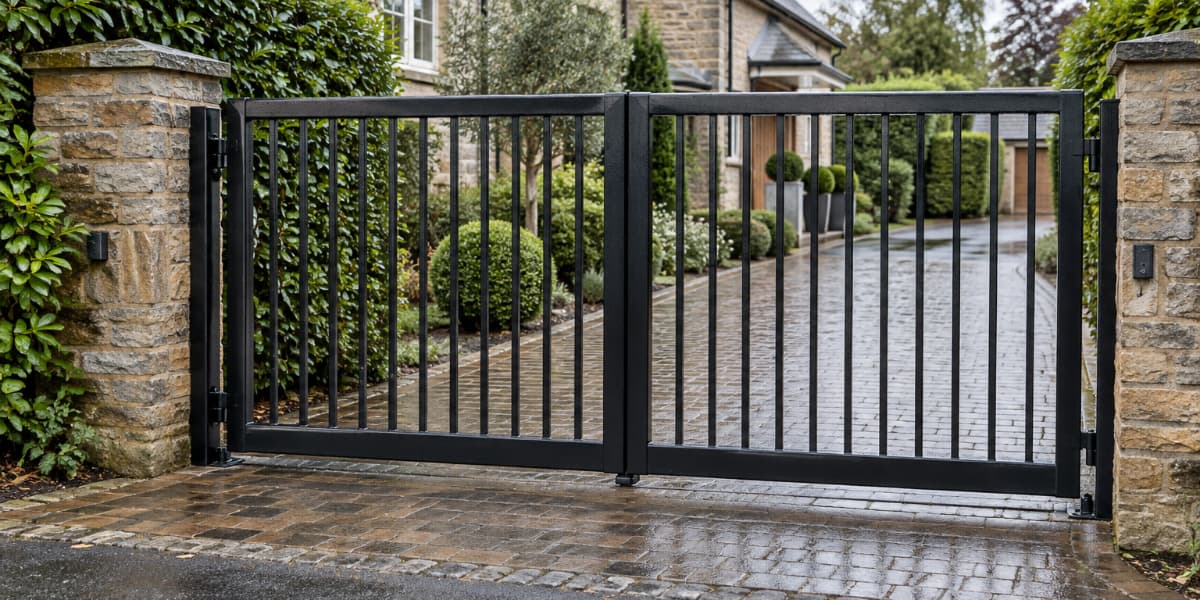
There’s plenty of choice across our range, whether you’re looking for driveway gates, something more decorative, a front garden gate or a taller gate for side access. If your home has a more traditional look, you might love curved tops, scrollwork and decorative finials. If you prefer something less ornate, we also have a contemporary range of modern metal gates. Many of our designs also have matching railings and fencing, so you can carry the same style across your boundary.
As we make our gates to order, you’re not limited to the exact sizes you see on our website. If you need something a little wider or taller, our team can help you work out what will suit your property. What’s more, all our metalwork comes with a 10-year workmanship guarantee.
You can take a look through all of our ranges right here on our website. Or, if you have any questions or would like some advice on choosing the right style and finish for your home, you can give our friendly team a call on 01254 236994 or email info@slwroughtiron.co.uk, and we’d be happy to help!


